AI Revolution: Driving Growth in Global Contact Centers
At Integral Technologies, we help businesses like yours transform their contact center operations by showcasing what’s possible with our innovative solutions. The examples you’ll find on this page are based on our core service offerings and are inspired by actual, real-life solutions.
We invite you to explore these use cases and see how we can help you accelerate your journey to AI success. To learn more about how we can help you with your specific needs, please don’t hesitate to contact us.

Contact Center Business Consulting
Use Case: The Actionable Dashboard
Many businesses struggle to effectively leverage their contact center data to improve performance and align technical solutions with strategic goals. We help you transform your customer experience by first understanding it, then optimizing it with the right technology.
An example of this is a financial company that provides loans to small businesses. The company’s old phone system was not user-friendly and lacked crucial analytics, making it difficult to improve operations and track performance. They were unable to measure call volume, missed calls, or identify peak times, which led to inefficient staffing and long resolution times.
By implementing a new AI-powered communications solution, such as Dialpad, that integrates with their existing CRM like Salesforce, a business can create a custom dashboard that delivers real-time analytics. This allows them to see when call volumes spike and identify bottlenecks, enabling them to make data-driven decisions to improve efficiency. For instance, one company was able to reduce its average resolution time from 48 hours to just 6 hours by gaining a clear, unified view of its customer data. This demonstrates how creating an actionable dashboard can lead to significant real-world results.

“This has completely transformed how we manage our customer support. The ability to see real-time data allows our managers to make smarter decisions, drastically reducing our resolution time and improving customer satisfaction.”
AI Contact Center Capabilities
Use Case: The Smart Extension
Companies often want to add AI to their contact center but are worried about the cost and complexity of a “rip-and-replace” project. We help you integrate AI seamlessly into your existing infrastructure to enhance customer experience without disrupting your operations.
A common challenge for businesses like insurance companies is automating routine inquiries such as “What’s my policy number?” or “Where is the nearest agent?”. Instead of a full system overhaul, a conversational AI platform can be integrated as a “smart extension” to an existing communications platform. The AI handles these routine calls and can seamlessly transfer a customer to a live agent if needed, with all the conversation context.
A real-life example of this is a contact center using an AI-powered assistant like Talkdesk‘s Copilot. This AI assistant listens to the conversation, guides the agent with relevant information, and provides assistance in real-time. This saves the agent time and improves the customer experience by ensuring a seamless handoff with full context.

“Our agents feel more empowered than ever. The AI assistant gives them the information they need the moment they need it, allowing them to provide a faster, more personalized experience for our customers.”
Avaya AI Integration
Use Case: Voicebot-to-Agent Transfer
Clients with legacy Avaya systems often want to add conversational AI, but need a seamless, non-disruptive way to connect the two platforms. We specialize in integrating modern AI solutions into your existing Avaya infrastructure to preserve your investment while enabling new capabilities.
A common challenge for universities and other large organizations is managing high volumes of basic student or customer inquiries, such as those about class schedules or financial aid. A real-life example of a solution to this is to integrate a new AI voicebot with their existing Avaya</u> system. The voicebot can accurately answer basic questions and, when needed, transfer the student to a live agent. The key is ensuring that the agent receives a full transcript of the bot’s conversation, so they can assist the student without asking them to repeat themselves. This intelligent orchestration can provide proactive service by anticipating a customer’s needs and connecting them to the perfect agent without lengthy explanations.

“The integration of the AI voicebot with our existing Avaya system has been seamless. The transfer of call context to our agents has drastically improved our efficiency and led to a much better experience for our students.”
Avaya Native Low-Code/No-Code Workflow Design
Use Case: Personalized Call Routing
Businesses need to quickly design and deploy automated customer experiences without a large software development team. We use low-code/no-code tools to empower your teams to create and modify workflows with speed and agility on your existing Avaya system.
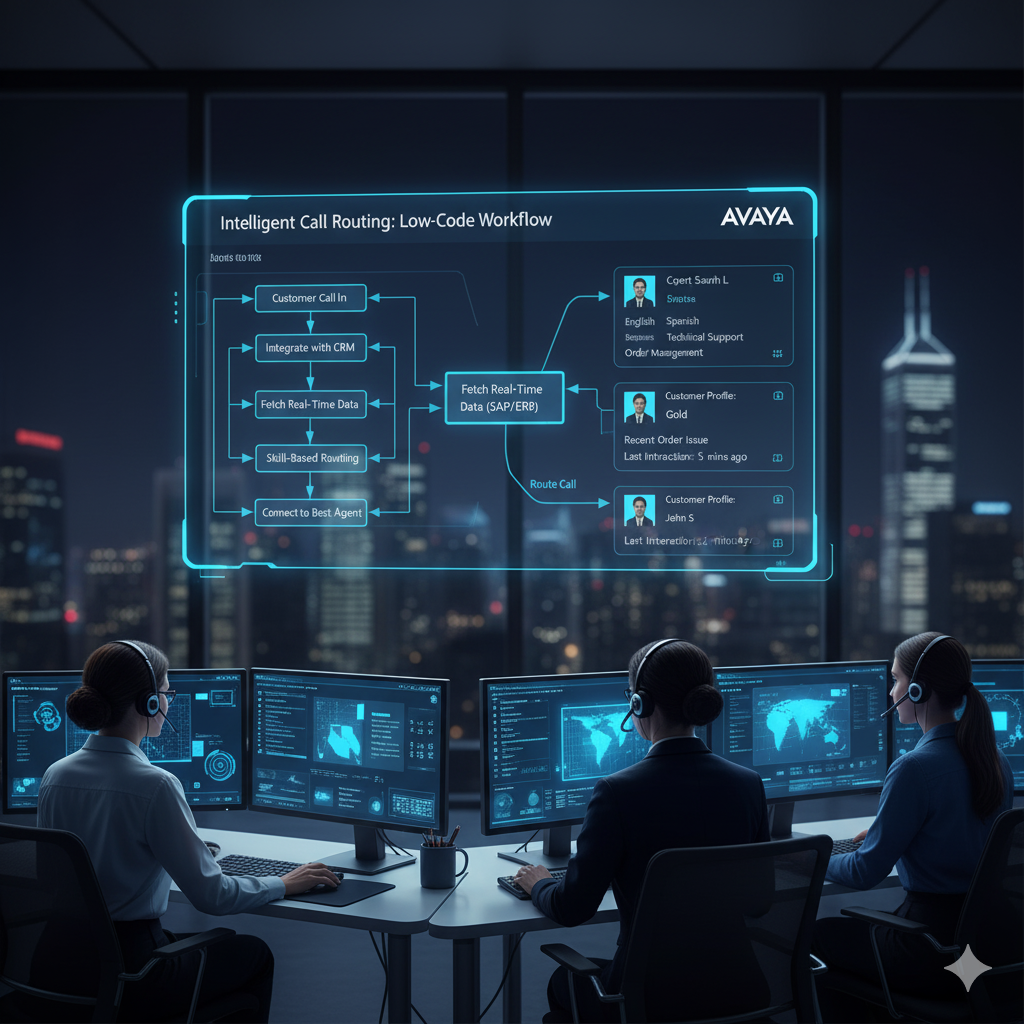
A frequent challenge for companies is routing callers based on real-time data to provide a personalized and efficient experience. For example, a travel company wants to route callers based on their flight status or loyalty program tier.
By using an Avaya low-code workflow, a business can integrate with its internal systems to pull real-time data. This allows for intelligently routing the call to the most appropriate agent who is equipped with the customer’s information. This approach simplifies the creation and management of complex workflows through a user-friendly, drag-and-drop interface, making it accessible for users of all technical levels.
“The ability to quickly design and deploy these personalized call flows has significantly improved our customer satisfaction. We can now adapt to changing business needs in a matter of minutes, not months.”
Omnichannel Orchestration
Use Case: A Unified Agent Desktop
Customer interactions are often fragmented across different channels, leading to inconsistent experiences and a lack of a single view of the customer. We help you unify these channels to create a seamless customer journey and a more efficient agent experience.
A common challenge for businesses like logistics companies is that their agents must switch between multiple applications—such as their softphone, CRM, and email client—to handle a single customer inquiry. This fragmentation slows down resolution times and creates a disjointed experience.
By using omnichannel orchestration, a business can unify all these channels into a single agent desktop, providing a 360-degree view of the customer. Solutions like Talkdesk CXA (Customer Experience Automation) platform can seamlessly orchestrate interactions across different systems, enabling agents to resolve issues faster and more efficiently.

Avaya Third-Party System Integration
Use Case: Automated Order Status
Businesses need to connect their new communication solutions to legacy or third-party enterprise systems to provide a complete customer experience. We help you integrate your Avaya contact center with these systems to ensure seamless data flow and a unified view of the customer.
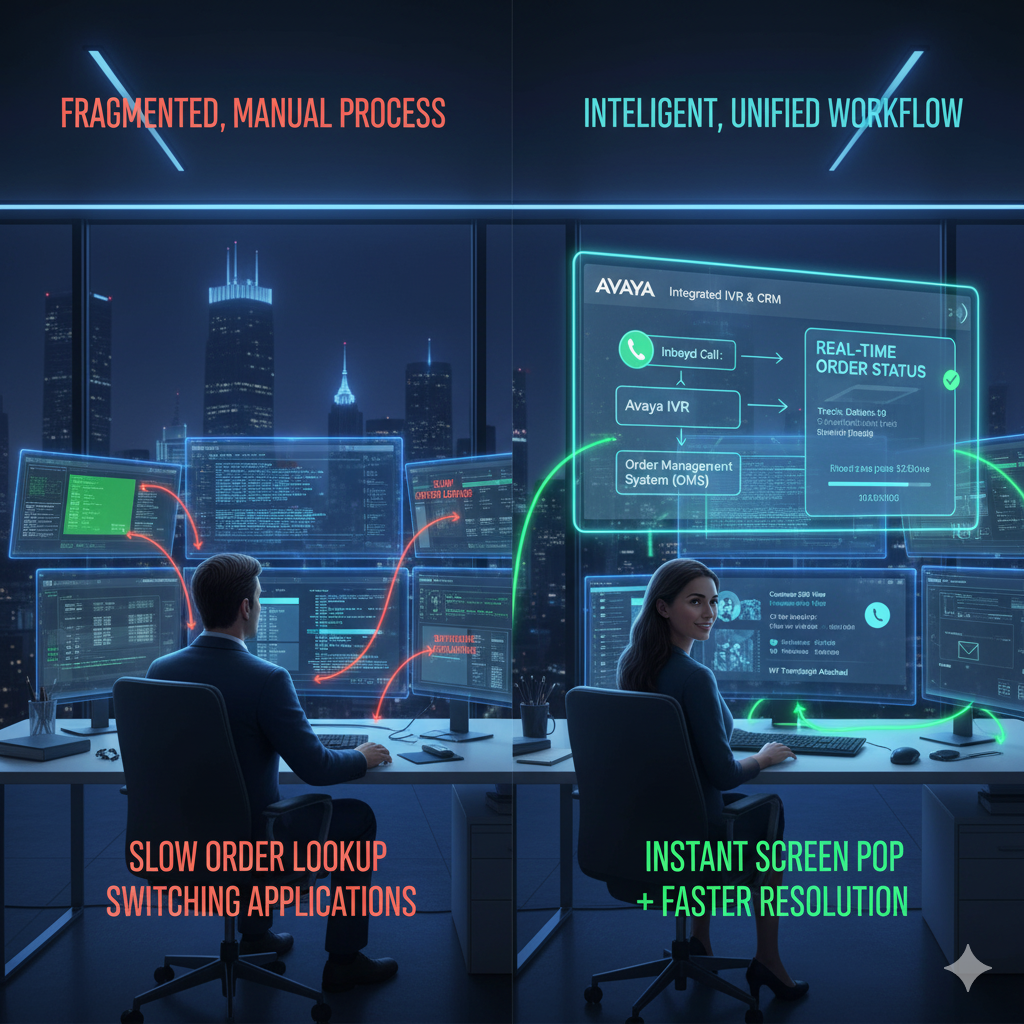
A common challenge for e-commerce companies is the high volume of inbound calls for order status updates. This ties up live agents who could be handling more complex customer service issues. A solution is to integrate their Avaya IVR with their Order Management System (OMS). This enables the IVR to pull real-time order status information and share it with the customer without the need for a live agent.
A real-world example of a similar integration is the way a health insurance provider can connect their on-premises Avaya system with a new cloud-based CRM using iPaaS expertise. This ensures that when an agent receives a call, the customer’s record automatically pops up on their screen, saving time and eliminating the need for manual lookups.
“By automating order status inquiries, we’ve significantly reduced our inbound call volume and freed up our agents to focus on the more complex issues that truly require their expertise.” Sources
Avaya Data Management
Use Case: The Agent-Empowerment Dashboard
Clients have valuable customer data scattered across disparate systems and need to unify it to create a complete view of the customer journey. We help you collect, normalize, and unify your data to empower your agents and improve decision-making.
A major challenge for financial services companies is providing their agents with a complete view of a customer’s history at the moment a call arrives. Often, this data is scattered across multiple systems, such as the Avaya system, a CRM, and a conversational AI platform.
A solution is to develop an agent desktop dashboard that pulls in and unifies data from all of these sources. This provides agents with the real-time context they need to deliver a more personalized and efficient experience. This approach creates a single, easy-to-use dashboard that helps proactively monitor system health and quickly identify and resolve issues, significantly reducing downtime.

“With our new agent-empowerment dashboard, our team no longer has to hunt for information across different screens. They have everything they need right in front of them, which has led to a noticeable improvement in our first call resolution rates.”
Avaya Native Cloud Deployment
Use Case: The Agile Contact Center
Businesses are often limited by the rigidity of their on-premises communication infrastructure and want to leverage the agility and scalability of the cloud. We help you design and deploy cloud-based or hybrid solutions to meet these needs, without a disruptive rip-and-replace project.
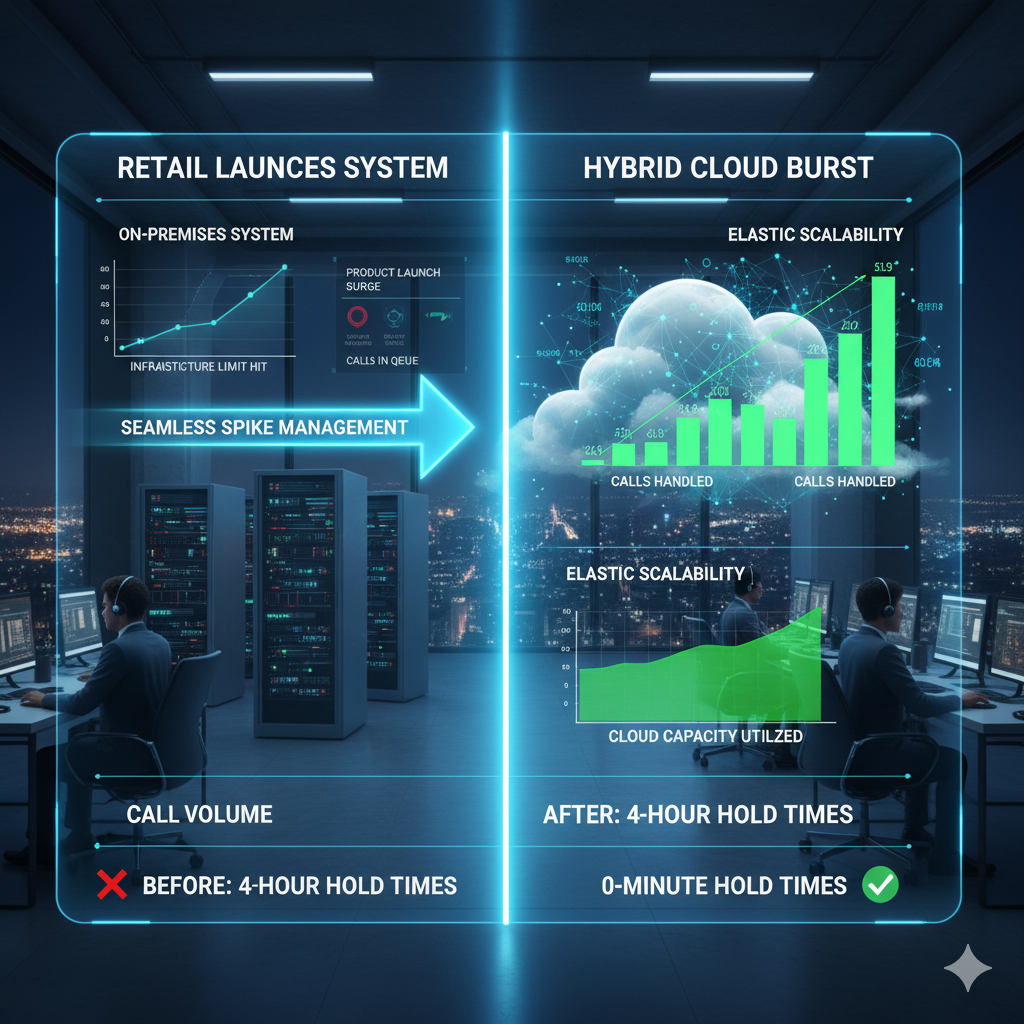
A common challenge for retail companies is managing massive spikes in call volume during a new product launch. Their on-premises Avaya system may not be able to scale to meet this temporary demand.
We solve this by designing a hybrid cloud solution that deploys a portion of the contact center to the cloud. This allows the business to handle the surge in calls seamlessly and then scale back down when demand returns to normal. The agility of this solution ensures that the company can meet customer demand without overhauling their existing infrastructure.
“The ability to scale our contact center to meet a massive spike in call volume for our new product launch was a game-changer. We seamlessly handled the demand and were able to scale back down just as easily, saving us from a significant investment in on-premises infrastructure.”
Platform Integration (iPaaS)
Use Case: The Unified Call Center
Companies need to connect their communication platforms to a multitude of other enterprise applications and communication channels to create a seamless customer experience. We use an Integration Platform as a Service (iPaaS) to securely connect all your systems and automate workflows.
A common challenge for health insurance providers is integrating their on-premises call center, like an Avaya system, with a new cloud-based CRM. This disconnect prevents agents from having a complete view of the customer when a call comes in.
Using an iPaaS solution, we can securely connect the two platforms. This ensures that when an agent receives a call, the customer’s record automatically pops up on their screen, eliminating the need for manual lookups and saving valuable time. The intuitive visual designer of an iPaaS tool, like CX Fabric, simplifies the creation and management of these workflows, making it accessible even for users without deep technical skills.
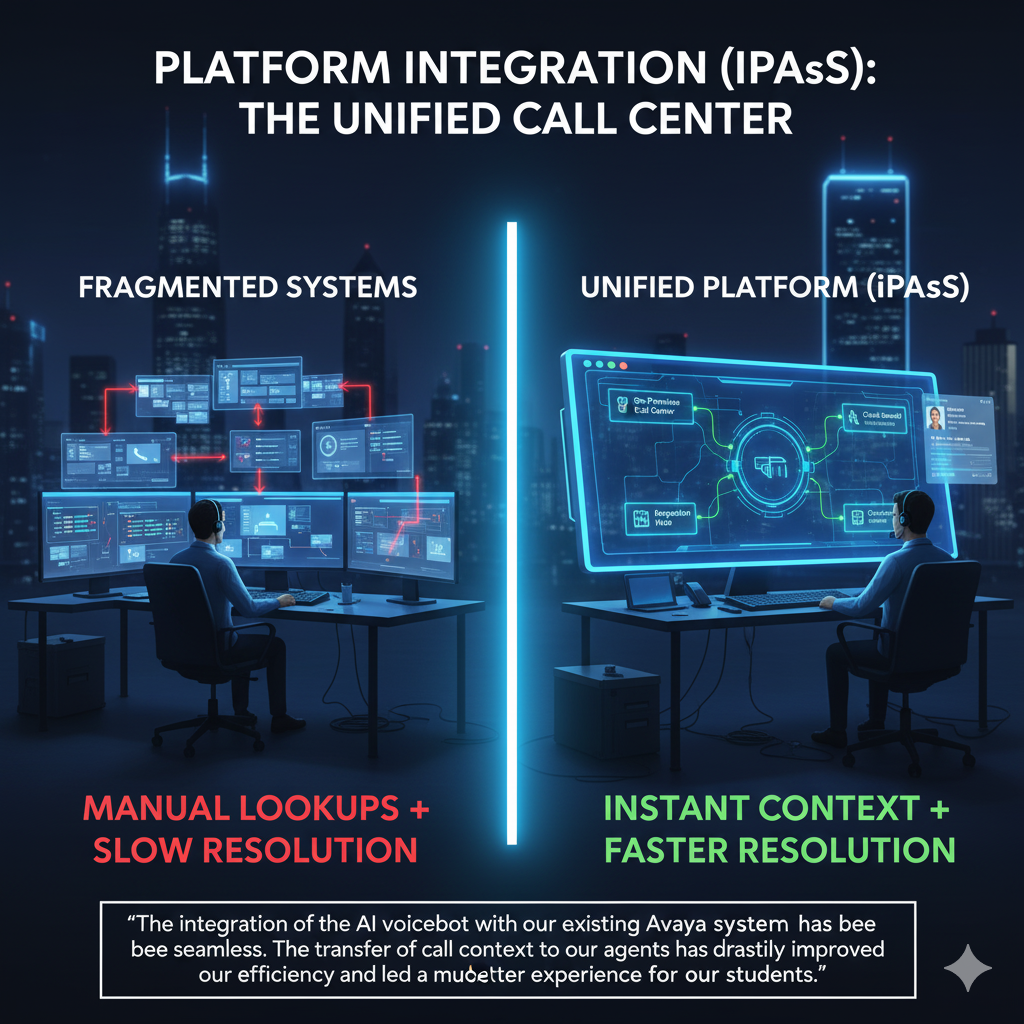
“By integrating our on-premises call center with our new cloud CRM, we’ve eliminated the need for agents to manually search for customer information. This has made our call center operations far more efficient and has a direct impact on customer satisfaction.”
Protecting Communication Systems
Use Case: The Proactive Dashboard
Businesses face increasing security threats, have a lack of visibility into their communication system’s health, and need to manage and troubleshoot complex infrastructure. We help you secure your communication systems and provide the tools for proactive monitoring and management.
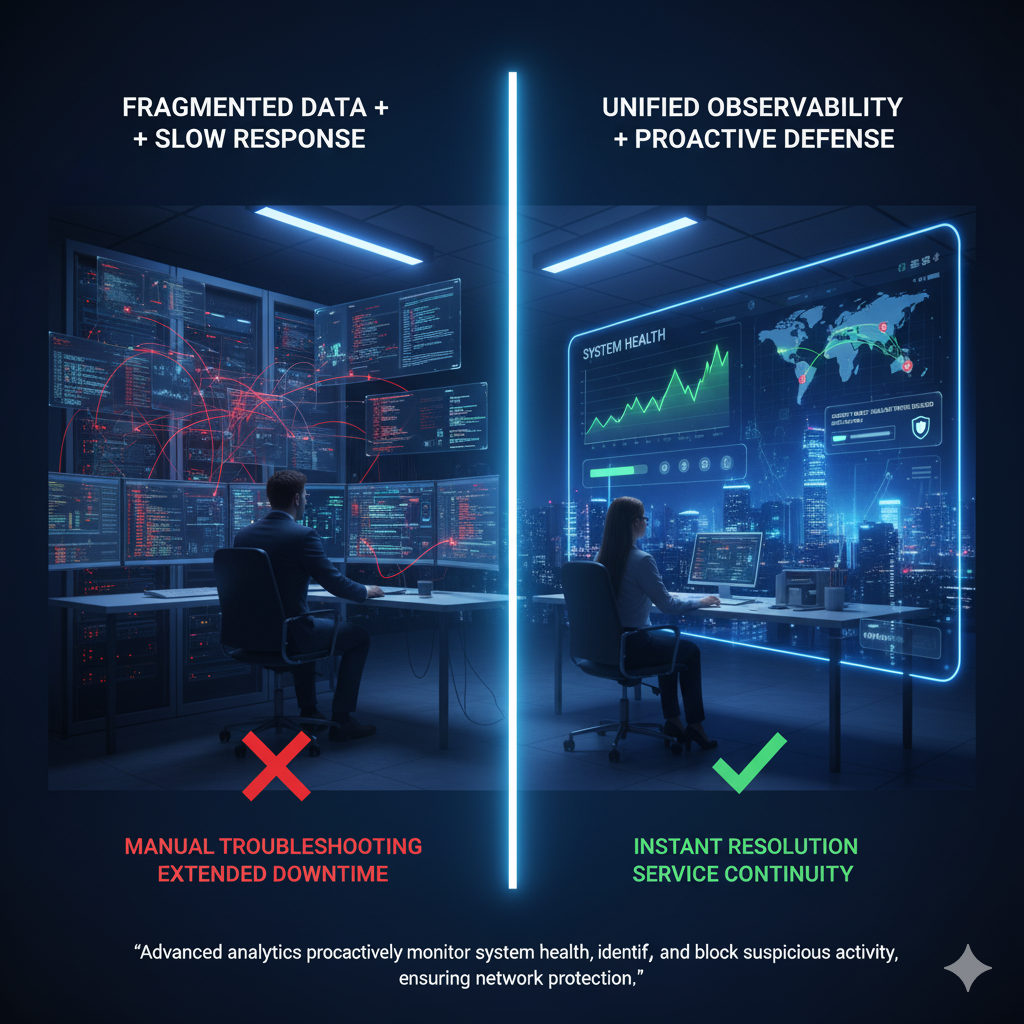
A common challenge for IT teams at companies like global logistics firms is spending hours manually sifting through logs from different systems to troubleshoot an issue. This leads to long resolution times and unnecessary downtime.
By implementing a centralized logging and observability platform, all communication system data can be unified. This provides a single, easy-to-use dashboard that helps them proactively monitor system health and quickly identify and resolve issues. For instance, a financial institution can deploy advanced Session Border Controller (SBC) analytics to monitor real-time traffic, identify malicious patterns, and automatically block suspicious calls, protecting the network and ensuring service availability for legitimate customers.
“Our team can now proactively identify and resolve issues before they impact our customers. The single, unified dashboard has reduced our troubleshooting time from hours to minutes, significantly improving our operational efficiency and network security.”